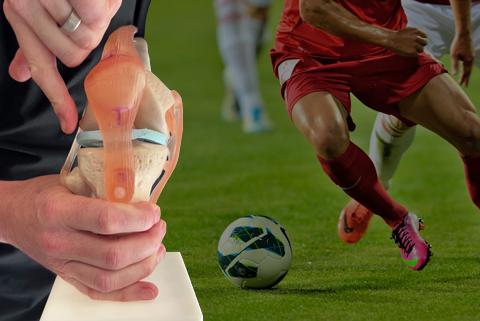
Meniscus Tears
When Do They Actually Need Surgery?
by Tim Keeley07 Sep 2026


As featured in The Daily Telegraph, Herald Sun and other News Corp publications around Australia.
Being told you have a torn meniscus can make it sound as though something inside your knee has physically broken and now needs to be surgically fixed.
But that is not always the case.
A meniscus tear is not one diagnosis with one treatment. Some tears respond very well to rehabilitation, while others may need earlier orthopaedic assessment or surgery.
The important questions are not simply whether an MRI shows a tear, but what type of tear you have, how it happened, what symptoms it is causing, and how your knee is functioning.
What Is the Meniscus?
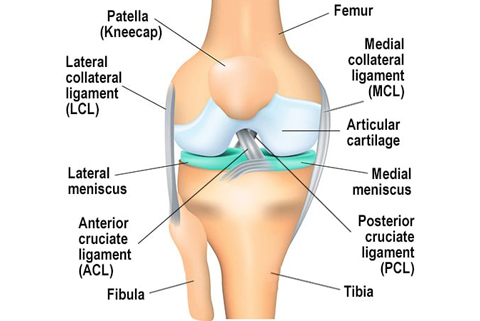
Each knee contains two menisci — a medial meniscus on the inside of the knee and a lateral meniscus on the outside.
These crescent-shaped structures sit between the femur and tibia and help distribute load through the knee joint, absorb force and contribute to joint stability.
That load-distribution role is one reason modern treatment aims to preserve as much healthy, functional meniscal tissue as possible whenever surgery is required.
I've Experienced Both Sides of This Myself
I've personally had three meniscus tears.
My first was a traumatic medial meniscus tear from a skiing injury. That tear required a surgical meniscal repair and I made a full functional recovery.
Since then, I've had two further degenerative meniscal tears that did not require surgery. Both were managed with progressive rehabilitation and I returned to full function.
That experience illustrates an important point: the word “tear” on an MRI does not automatically tell you what treatment you need.

Not All Meniscus Tears Are the Same
Meniscus tears can occur in very different ways.
A younger athlete may tear a meniscus suddenly during a twisting, pivoting or change-of-direction movement. In contrast, someone in their 40s, 50s or 60s may develop degenerative meniscal changes gradually, sometimes without remembering a specific injury at all.
Tear patterns can include:
- Vertical or longitudinal tears
- Radial tears
- Horizontal tears
- Flap tears
- Complex tears
- Bucket-handle tears
- Meniscal root tears
The location of the tear matters as well. The outer portion of the meniscus has a better blood supply than the inner portion, which can influence healing potential and whether a tear may be suitable for surgical repair.
This means a traumatic longitudinal tear in a younger athlete can be a very different clinical problem from a degenerative horizontal tear seen on an MRI in a middle-aged person with gradually developing knee pain.
When Can Rehabilitation Be the First Option?
For many people — particularly those with degenerative meniscal tears without a true mechanical block — rehabilitation can be an appropriate first approach.
The aim is not necessarily to make the tear disappear from the MRI.
The goal is to restore the movement, strength, load tolerance and function of the knee.
Depending on the individual, rehabilitation may include:
- Reducing pain and swelling
- Restoring full knee extension and comfortable knee flexion
- Rebuilding quadriceps strength
- Improving hip and gluteal strength
- Developing single-leg strength and control
- Progressing squatting, stairs and walking tolerance
- Progressively returning to running, gym training or sport where appropriate
Rehabilitation should also progress as the knee improves. Early exercises may focus on movement and quadriceps contraction, but later rehabilitation should build towards heavier strength work, single-leg control and the specific activities you want to return to.
When Might a Meniscus Tear Need Earlier Surgical Assessment?
There are some situations where I would be more interested in obtaining an orthopaedic opinion earlier.
1. The Knee Is Genuinely Locked
A true locked knee means that something is physically preventing the knee from fully straightening or moving normally.
One possible cause is a displaced bucket-handle meniscal tear.
This is different from a knee that simply feels stiff because it is painful or swollen.
A mechanically blocked knee requires prompt assessment.
2. The Tear May Be Repairable
Some acute traumatic tears may be suitable for meniscal repair, particularly when the tear pattern and location have healing potential.
In these cases, timing can matter because the objective is to preserve and repair the meniscus rather than simply remove damaged tissue.
3. The Tear Is Displaced or Restricting Knee Movement
Current orthopaedic guidance supports earlier surgical consideration for some displaced acute meniscal tears, particularly when they restrict normal knee range of motion.
4. Significant Symptoms Continue Despite Appropriate Rehabilitation
If someone has completed an appropriate period of progressive rehabilitation but continues to experience substantial pain, recurrent swelling or mechanical symptoms that significantly restrict normal activity, further assessment may be warranted.
This does not automatically mean rehabilitation has “failed”.
How the knee responds to rehabilitation becomes another important piece of information when deciding what to do next.
What About Clicking, Catching and Giving Way?
A clicking or cracking knee does not automatically mean that meniscal surgery is required.
What concerns me more is the combination of symptoms and functional loss.
This may include:
- Recurrent significant swelling
- Persistent joint-line pain
- Loss of knee movement
- A true mechanical block
- Repeated giving way
- Inability to return to normal activity despite appropriate rehabilitation
These findings need to be interpreted alongside the history of the injury, a physical examination and imaging where appropriate.
Does an MRI Decide Whether You Need Surgery?
No.
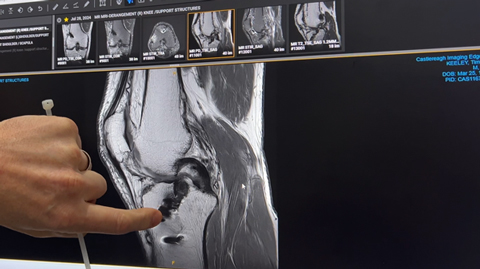
MRI is very useful when used in the right clinical situation, but it should be interpreted as part of the overall clinical picture rather than treated as the diagnosis in isolation.
We still need to consider:
- How the injury occurred
- Where the pain is located
- Swelling
- Knee range of movement
- Strength
- Mechanical symptoms
- Functional limitations
- Associated ligament, cartilage or other knee injuries
- The MRI findings
The scan needs to match the person.
Meniscal Repair and Partial Meniscectomy Are Not the Same
Patients often refer to both procedures simply as “meniscus surgery”, but they are quite different.
Meniscal Repair
A meniscal repair attempts to preserve and heal the torn tissue.
Rehabilitation is usually more protected and takes longer because the repaired meniscus needs time to heal.
Partial Meniscectomy
A partial meniscectomy removes the unstable or damaged portion of the meniscus.
Early recovery may be faster than after a repair, but there is also less meniscal tissue remaining to help distribute load through the knee.
When surgery is indicated, current guidance recommends preserving as much functional meniscal tissue as possible. :contentReference[oaicite:1]{index=1}
What Should You Ask If You've Been Told You Have a Meniscus Tear?
Instead of simply asking whether the scan looks “bad”, useful questions include:
- Was this an acute traumatic tear or a degenerative finding?
- What type of tear is it?
- Is any part of the meniscus displaced?
- Can I fully straighten my knee?
- Is there significant or recurrent swelling?
- Does the tear have potential to be repaired?
- Are there associated ACL, cartilage or other knee injuries?
- Have I completed an appropriate rehabilitation program?
The Bottom Line
A meniscus tear does not automatically mean surgery.
For many degenerative tears and some non-displaced tears, progressive rehabilitation can be an appropriate first approach.
However, some acute injuries — particularly mechanically blocked knees, displaced tears restricting motion and potentially repairable tears — deserve earlier specialist assessment. :contentReference[oaicite:2]{index=2}
The important question is not simply:
“Do I have a meniscus tear?”
It is:
“What type of tear do I have, what symptoms is it causing, how is my knee functioning, and what treatment is most appropriate for me?”
About Tim Keeley
Tim Keeley, B.Phty, Cred.MDT, APAM, is the founder and Principal Physiotherapist of Physio Fitness, a sports injury and rehabilitation clinic in Bondi Junction, Sydney.
With more than 27 years of clinical experience and over 20,000 treatments performed, Tim specialises in sports, fitness and post-operative rehabilitation.
He is also the founder of Physio Rehab, an online platform providing structured injury and surgery rehabilitation programs, professional education and an extensive Physiotherapy exercise-video library used by people around the world.
Disclaimer: These exercises provide general information only and are not a substitute for individual medical or Physiotherapy advice. Stop if an exercise causes sharp or increasing pain. Anyone recovering from an injury or operation should follow the advice of their treating Physiotherapist, doctor or surgeon.
👉 Book your consultation today or call us on (02) 9389 9100 to start your recovery.

Principal Physiotherapist