Lower Back Pain
Should You Stretch It or Strengthen It?
by Tim Keeley17 Oct 2026


As featured in The Daily Telegraph, Herald Sun and other News Corp publications around Australia.
When your lower back feels tight or sore, stretching is often the first thing you try. You twist, bend or pull your knees towards your chest, hoping to loosen it up.
Sometimes that helps. Other times, the relief lasts only a few minutes, or your back feels more irritated afterwards.
So, should you stretch your lower back or strengthen it?
For many people, both have a role. The important part is choosing the right movements, at the right level, for your particular back problem.
Gentle mobility can help you move more comfortably. Strengthening can gradually rebuild your ability to tolerate daily activities, lifting, exercise and sport. Neither needs to involve forcing your way through pain.
Why Does Your Lower Back Feel So Tight?
A feeling of tightness does not necessarily mean a muscle has become short and needs a strong stretch.
When your back is painful, the surrounding muscles may increase their tension as a protective response. This muscle guarding can make bending, turning or getting out of a chair feel stiff and restricted.
You may also start moving less, avoiding certain positions or holding your trunk rigid throughout the day. Over time, normal movement can begin to feel more difficult.
The aim is to understand what is contributing to your symptoms, then gradually restore comfortable movement and the capacity to do the things you need.
When Can Stretching and Mobility Help?
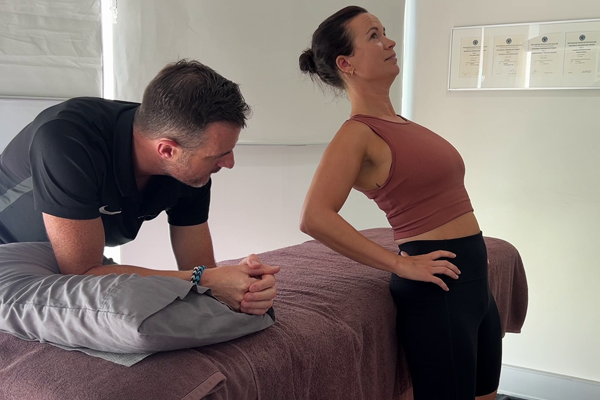
Gentle movement can be useful when your back feels stiff, particularly after sitting or staying in one position.
However, stretching harder is not always better. A movement that helps one person may aggravate another, especially when leg pain or nerve symptoms are involved.
Pay attention to how you feel during the movement and afterwards. A suitable exercise should leave your symptoms manageable and your movement the same or easier.
If a stretch repeatedly increases your pain, causes tingling or sends symptoms further down your leg, stop and have it assessed.
When Should You Start Strengthening?
You do not always need to wait until every symptom has disappeared before beginning strengthening.
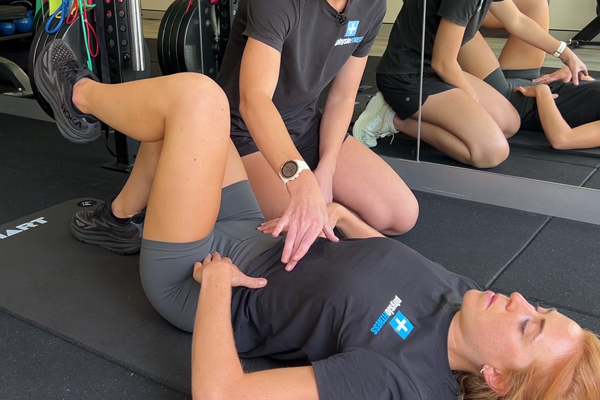
Low-load exercises can provide a manageable starting point for rebuilding muscle control and confidence. As your symptoms settle and your capacity improves, these exercises can progress towards the demands of your work, training and sport.
This does not mean that every sore back is weak, or that your core needs to stay tightly braced all day. Strengthening is about gradually increasing what you can comfortably do.
The following exercises provide two mobility options and two introductory strengthening options. They are examples rather than a routine everyone with back pain should perform.
1. Lumbar Rotation
This exercise introduces gentle rotation through the lower back and hips.
- Lie on your back with one knee bent towards your chest.
- Hold that knee with your opposite hand.
- Keep your other arm out to the side and the opposite shoulder resting on the floor.
- Slowly guide your bent knee across your body.
- Move only through a comfortable range, then return to the starting position.
Suggested starting amount:60sec x 2 -3 times on each side.
Avoid pulling your knee forcefully towards the floor. Gradually increase the movement as your back allows.
If your pain is one-sided, do not assume both directions will suit you equally. Use the direction advised by your Physiotherapist.
|
|
2. Prone Lumbar Extension
Prone extension explores backward movement of the lower back when this direction suits your symptoms. It is sometimes called a prone press-up or McKenzie extension exercise.
- Lie on your stomach with your hands beside your shoulders.
- Gently press through your hands to raise your upper body.
- Allow your lower back to move into extension while keeping your pelvis resting on the surface.
- Keep your buttocks and legs relaxed as much as possible.
- Lower yourself slowly and repeat.
Suggested starting amount: 5 gentle repetitions, increasing towards 10 if comfortable.
You do not need to straighten your elbows fully. Begin with the range your back allows.
This movement can be helpful for selected back problems, but it is not suitable for every person or every disc injury.
Stop if it increases leg pain, tingling or numbness, particularly if symptoms spread further down the leg. If you cannot comfortably lie on your stomach, have the exercise modified before trying to press up.
|
|
3. Bird Dog
The bird dog helps build trunk control while moving your arms and legs.
- Begin on your hands and knees, with your hands beneath your shoulders and knees beneath your hips.
- Find a comfortable middle position for your lower back.
- Gently engage your abdominal muscles while continuing to breathe.
- Reach one arm forward.
- Once balanced, extend the opposite leg behind you.
- Keep your pelvis level and avoid arching or twisting your lower back.
- Return slowly, then change sides.
Suggested starting amount: 5 repetitions on each side, holding each repetition for around 3–5 seconds.
Focus on reaching long rather than lifting your arm and leg high.
If the full movement is too difficult, begin with the arm alone or slide one foot backwards along the floor. Progress when you can maintain control without increasing symptoms.
|
|
4. Glute Bridge
The glute bridge introduces strengthening for the gluteal muscles while you control the position of your trunk and pelvis.
- Lie on your back with your knees bent and feet approximately hip-width apart.
- Gently brace your abdominal muscles.
- Push through your heels and lift your hips.
- Lift only as far as you can without arching your lower back.
- Pause briefly, then lower slowly.
Suggested starting amount: 1–2 sets of 8–10 repetitions.
Think about lifting with your hips rather than pushing your stomach towards the ceiling. Keep breathing and avoid a forceful back arch at the top.
If your back becomes sore, reduce the height or number of repetitions. If that does not help, have the exercise reviewed.
|
|
How Should You Combine Mobility and Strengthening?
You might begin with a small amount of whichever mobility movement makes your back feel easier, followed by a manageable strengthening exercise.
You do not need to complete all four exercises, and you do not need to progress every exercise at once.
Monitor your response later that day and the following morning. If symptoms remain noticeably worse, reduce the range, repetitions or difficulty and seek advice if the response continues.
As these exercises become easier, rehabilitation should progress towards your goals. That may include:
- Walking further
- Tolerating a full workday
- Returning to the gym
- Rebuilding your ability to squat and lift
- Returning to running, exercise and sport
Should You Rest a Sore Back?
Short periods of relative rest may help you manage a flare-up, but spending prolonged periods in bed usually is not helpful.
Try to maintain tolerable daily movement. Short walks, regular changes of position and temporarily modifying heavier activities can help you stay active while your symptoms settle.
When Should You See a Physiotherapist?
Arrange an assessment if:
- Your pain is affecting walking, sleep, work or exercise
- You keep experiencing similar flare-ups
- Exercises repeatedly aggravate your symptoms
- You have pain travelling into your buttock or leg
- You are unsure which movements are suitable
- Your symptoms are persisting or getting worse
At Physio Fitness in Bondi Junction, we assess your symptoms, movement, strength and activity demands to help develop an individual rehabilitation plan.
That may involve modifying aggravating activities, selecting movements that suit your presentation and progressively rebuilding your strength and confidence.
When Does Back Pain Need Urgent Medical Assessment?
Seek emergency medical assessment if you develop new difficulty passing urine, loss of bladder or bowel control, numbness around the groin or saddle region, or severe or worsening weakness in both legs.
Back pain following significant trauma, or accompanied by fever or feeling very unwell, also needs prompt medical review.
Get a Plan for Your Lower Back
Stretching may help you move more comfortably, while strengthening helps build your capacity for everyday activities and exercise.
The right balance depends on your symptoms, your stage of recovery and what you want to return to.
If you are unsure where to start, our Physiotherapists at Physio Fitness in Bondi Junction can assess your back and guide your rehabilitation.
About Tim Keeley
Tim Keeley, B.Phty, Cred.MDT, APAM, is the founder and Principal Physiotherapist of Physio Fitness, a sports injury and rehabilitation clinic in Bondi Junction, Sydney.
With more than 27 years of clinical experience and over 20,000 treatments performed, Tim specialises in sports, fitness and post-operative rehabilitation.
He is also the founder of Physio Rehab, an online platform providing structured injury and surgery rehabilitation programs and an extensive Physiotherapy exercise-video library.
Disclaimer: This article provides general information only and is not a substitute for individual medical or Physiotherapy advice. Exercise selection and progression should be tailored to your condition. Stop exercises that worsen your symptoms and seek advice from your treating healthcare professional.
👉 Book your consultation today or call us on (02) 9389 9100 for help with your lower back pain and rehabilitation.

Principal Physiotherapist