
Frozen Shoulder
Why It Takes So Long to Recover
by Tim Keeley14 Sep 2026


As featured in The Daily Telegraph, Herald Sun and other News Corp publications around Australia.
Frozen shoulder can be one of the most frustrating shoulder conditions to experience.
It can start with pain, particularly at night or when reaching, and gradually progress into significant stiffness that makes everyday tasks such as getting dressed, reaching behind your back or lifting your arm overhead increasingly difficult.
The medical term is adhesive capsulitis, although frozen shoulder is the term most people are familiar with.
One of the most common questions patients ask is:
“Why is this taking so long to get better?”
The answer lies in what is actually happening inside the shoulder joint.
As featured in The Daily Telegraph, Herald Sun and other News Corp publications around Australia.
What Is Frozen Shoulder?
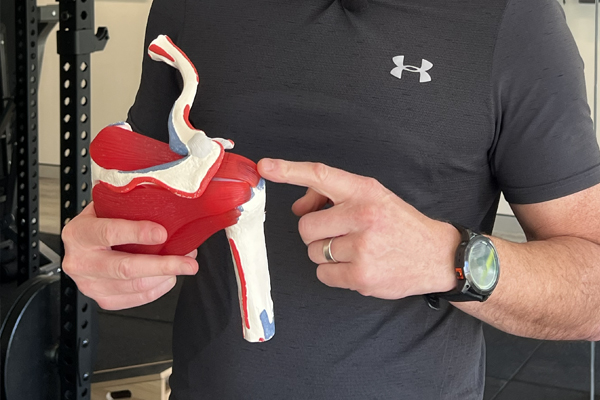
Frozen shoulder is a condition where the capsule surrounding the shoulder joint becomes painful, thickened and progressively restricted.
The shoulder capsule is a flexible sleeve of connective tissue that surrounds the ball-and-socket joint.
With frozen shoulder, inflammatory and fibrotic changes can develop within this tissue, causing the capsule to become less elastic and the joint to lose movement. Histological studies describe fibroblastic and myofibroblastic activity with increased collagen deposition and capsular contracture.
This is why frozen shoulder is different from simply having tight shoulder muscles.
The restriction is occurring at the joint capsule itself.
What Does Frozen Shoulder Feel Like?
Typical symptoms include:
- Progressive shoulder pain
- Pain at night or when lying on the affected side
- Increasing difficulty lifting the arm overhead
- Difficulty reaching behind the back
- Restricted external rotation
- Loss of both active and passive shoulder movement
That final point is important.
With frozen shoulder, the joint is restricted not only when you try to move it yourself, but also when someone else attempts to move the shoulder passively.
That pattern helps distinguish adhesive capsulitis from a number of other shoulder conditions.
Why Does Frozen Shoulder Take So Long?

Frozen shoulder is not simply a short-term muscle strain.
The shoulder capsule itself is undergoing biological and structural changes, and those changes can take a considerable amount of time to settle and remodel.
Traditionally, frozen shoulder has been described in three broad phases:
1. Freezing Phase
Pain often becomes increasingly prominent and shoulder movement gradually reduces.
Night pain can be particularly troublesome during this stage.
2. Frozen Phase
Pain may begin to settle somewhat, but stiffness can remain significant and function may still be considerably restricted.
3. Recovery or Thawing Phase
Movement and function may gradually improve.
However, these stages should not be viewed as rigid timelines.
The traditional belief that every frozen shoulder progresses neatly through three phases and eventually returns completely to normal without treatment has been challenged. Some people continue to have pain, stiffness or functional limitations for much longer.
Why Do the Muscles Become Weak?
Frozen shoulder does not only affect joint movement.
Pain and reduced use of the arm can also lead to pain-inhibited muscle contraction, reduced strength and loss of confidence using the shoulder.
The rotator cuff, deltoid and scapular muscles may become deconditioned simply because the arm is not moving or loading normally.
This is why rehabilitation should not focus exclusively on stretching.
As symptoms allow, progressive strengthening is also important for restoring normal shoulder capacity.
What Causes Frozen Shoulder?
Sometimes frozen shoulder develops without an obvious trigger. This is often described as primary or idiopathic frozen shoulder.
In other cases, it can develop after:
- Shoulder injury
- Shoulder surgery
- A period of immobilisation
- Reduced use of the arm because of pain
Certain medical conditions, including diabetes and thyroid disorders, are also associated with an increased risk of frozen shoulder.
Why Physiotherapy Matters
Physiotherapy for frozen shoulder is not simply about forcing the shoulder through as much movement as possible.
The rehabilitation approach should reflect the irritability of the shoulder, the degree of stiffness, strength loss and stage of recovery.
A highly painful shoulder may initially tolerate only gentle movement and low-load muscle work.
As pain settles and the shoulder becomes less irritable, exercises can progressively target:
- Shoulder range of motion
- External rotation
- Flexion and elevation
- Rotator cuff strength
- Scapular control
- Functional reaching and lifting
Current evidence-based pathways include Physiotherapy among the conservative management options for frozen shoulder, alongside interventions such as corticosteroid injection and hydrodilatation in selected patients.
4 Exercises That May Be Used During Frozen Shoulder Rehabilitation
The appropriate exercises depend on how painful and restricted your shoulder is.
These four exercises provide examples of movements that may be used at different stages of rehabilitation.
1. Passive External Rotation With a Pole
External rotation is often one of the most noticeably restricted movements in frozen shoulder.
Lie on your back with the elbow of the affected arm bent to 90 degrees and kept close to your side.
Hold a pole or broomstick in both hands. Use your unaffected arm to gently push the affected forearm outwards, externally rotating the shoulder.
Hold a pole or broomstick in both hands. Use your unaffected arm to gently push the affected forearm outwards, externally rotating the shoulder.
|
|
2. Isometric External Rotation With a Band
This helps maintain strength through the rotator cuff while the shoulder external rotation movement is painful or is restricted.
Stand with your elbow bent to approximately 90 degrees and held near your side.
Hold this position against the resistance of the band while keeping the elbow close to your body.
The movement is to be performed as a static contraction for 10-30sec.
|
|
3. Passive-Assisted Shoulder Flexion lying down
Lie on your back and use your unaffected hand to support the affected arm.
Slowly guide both arms upwards towards and, as movement improves, over your head.
Allow the good arm to do most of the work so the affected shoulder remains relaxed.
Lying down reduces the demand of gravity and can make it easier to maintain shoulder elevation when the joint is painful and stiff.
|
|
4. Shoulder Extension using a band
This works the muscles around the shoulder blade and posterior shoulder, helping maintain strength and control while movement at the shoulder joint itself is restricted.
Secure a resistance band in front of you and hold it with one hand
Draw the shoulder blade gently backwards, then pull the hand backwards, keeping your elbow straight.
Keep the chest relaxed and avoid shrugging the shoulders.
|
|
Important: These exercises are examples rather than a complete frozen shoulder program. The appropriate range, resistance and progression depend on your pain, stiffness and stage of recovery.
Should You Push Through the Pain?
More aggressive stretching is not automatically better.
If the shoulder is highly irritable, repeatedly forcing it into painful end-range positions may simply increase symptoms and guarding.
Exercise intensity should be matched to the stage and irritability of the shoulder.
As symptoms settle, range and resistance can be progressed more assertively.
Do You Need an Injection?
Corticosteroid injections can be considered in some patients, particularly where pain and inflammation are prominent during the earlier stages.
They are not a replacement for rehabilitation, but reducing pain may make it easier to restore movement and participate in Physiotherapy.
Research suggests that combining corticosteroid injection with Physiotherapy may provide greater short-term improvement than Physiotherapy alone in some patients.
Hydrodilatation may also be considered in selected cases, depending on the clinical presentation and advice of your doctor or specialist.
When Should You Get Your Shoulder Assessed?
Consider having your shoulder assessed if:
- Shoulder pain is progressively worsening
- You are losing movement over time
- Night pain is regularly disturbing your sleep
- You cannot comfortably reach overhead or behind your back
- The shoulder has become stiff following an injury or surgery
- Your symptoms are not improving with appropriate self-management
Frozen shoulder is primarily a clinical diagnosis, although imaging may sometimes be used to exclude other causes of shoulder pain and stiffness.
Key Points
Frozen shoulder is more than simply a tight shoulder.
Changes within the joint capsule can cause significant pain, progressive stiffness and loss of shoulder function, and recovery can take considerable time.
The aim of rehabilitation is not to aggressively force the shoulder back to normal overnight.
It is to manage pain and irritability, progressively restore movement, rebuild muscle strength and gradually return the shoulder to normal function.
A Physiotherapist can assess the degree of capsular restriction, determine how irritable the shoulder is and build a rehabilitation program appropriate to your stage of recovery.
About Tim Keeley
Tim Keeley, B.Phty, Cred.MDT, APAM, is the founder and Principal Physiotherapist of Physio Fitness, a sports injury and rehabilitation clinic in Bondi Junction, Sydney.
With more than 27 years of clinical experience and over 20,000 treatments performed, Tim specialises in sports, fitness and post-operative rehabilitation.
He is also the founder of Physio Rehab, an online platform providing structured injury and surgery rehabilitation programs, professional education and an extensive Physiotherapy exercise-video library used by people around the world.
Disclaimer: These exercises provide general information only and are not a substitute for individual medical or Physiotherapy advice. Stop if an exercise causes sharp or increasing pain. Anyone recovering from an injury or operation should follow the advice of their treating Physiotherapist, doctor or surgeon.
👉 Book your consultation today or call us on (02) 9389 9100 to start your recovery.

Principal Physiotherapist